
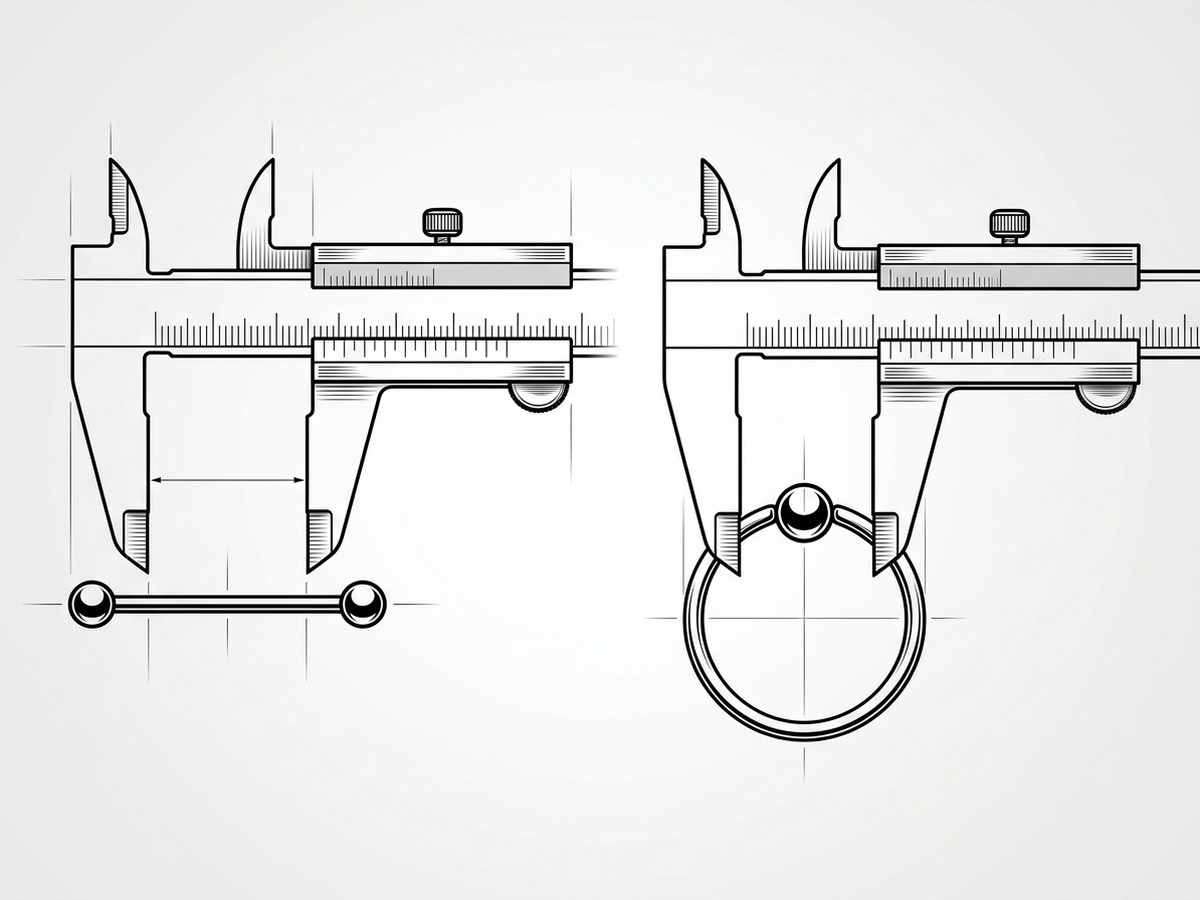
What It Is
Piercing size describes the measurements that make jewelry fit correctly. The main measurements are gauge, wearable bar length, ring diameter, and sometimes ball or end size. These numbers can look confusing at first, but they are the difference between jewelry that feels comfortable and jewelry that presses, shifts, or catches. Because every body and piercing placement is different, size should be chosen carefully.
Common Jewelry Types
Straight barbells are used for tongue piercings and some ear or industrial placements. Labret studs and flat backs are used for lip and ear placements. Curved barbells are common for eyebrow and navel piercings. Rings, hoops, clickers, circular barbells, and captive bead rings are used for septum, lip, ear, and other placements. Each jewelry type has its own sizing method, so do not assume one measurement applies to every style.
Common Sizes
Gauge measures thickness: lower gauge numbers are thicker. Bar length is the wearable straight section between the ends. Ring diameter is the inside measurement of the ring, not the outside. Ball size or end size affects appearance and comfort. A 14G barbell and a 16G barbell are not interchangeable unless your piercing is sized for both, and a ring with the wrong inner diameter may feel too tight or too loose even if the gauge is correct.
How To Choose Jewelry
The easiest starting point is to measure jewelry that already fits well. Use calipers if available, or compare against a reliable size chart. For barbells, measure only the wearable shaft. For rings, measure the inside opening from one inner edge to the opposite inner edge. If you want a tighter or looser look, change diameter slowly and avoid extreme jumps. For decorative ends, make sure the end size suits the placement and does not rub against teeth, gums, skin, or nearby piercings.
Safety Note
For healing, irritated, swollen, or painful piercings, consult a professional piercer or healthcare provider before changing size or style. Do not stretch, downsize, or force jewelry without professional guidance.
How To Measure More Accurately
Use a clean ruler or calipers and measure jewelry outside the body. For straight barbells and labret studs, measure the wearable bar only, from the inside of one end to the inside of the other end. For curved barbells, measure the straight distance between the two ends, not the curve along the bar. For rings and hoops, measure the inner diameter across the open center of the ring. Outside diameter is not the same measurement and can lead to ordering the wrong size.
Gauge is the thickness of the jewelry, and it is not measured the same way as length. A smaller gauge number means thicker jewelry. If a product uses millimeters and your old jewelry uses gauge, compare with a reliable conversion chart. Do not force a thicker gauge into a piercing that was not sized for it. Stretching or changing gauge should be done with professional guidance.
Before You Order
Write down your current size before browsing: gauge, length or diameter, and end size. This prevents confusing a 1.2 mm bar with a 12 mm length or a 3 mm ball. If you are buying several pieces, check every variation before checkout because different colors or finishes may have different size options. For paired or stacked looks, also check whether the item is sold as one piece or as a pair.
Comfort is the final test. Jewelry that is technically the right gauge can still be wrong if it is too short, too tight, too heavy, or too large for the placement. If a piercing is healing, swollen, painful, or irritated, consult a professional piercer or healthcare provider before changing jewelry. Do not use a new size as a way to solve irritation without professional advice.